
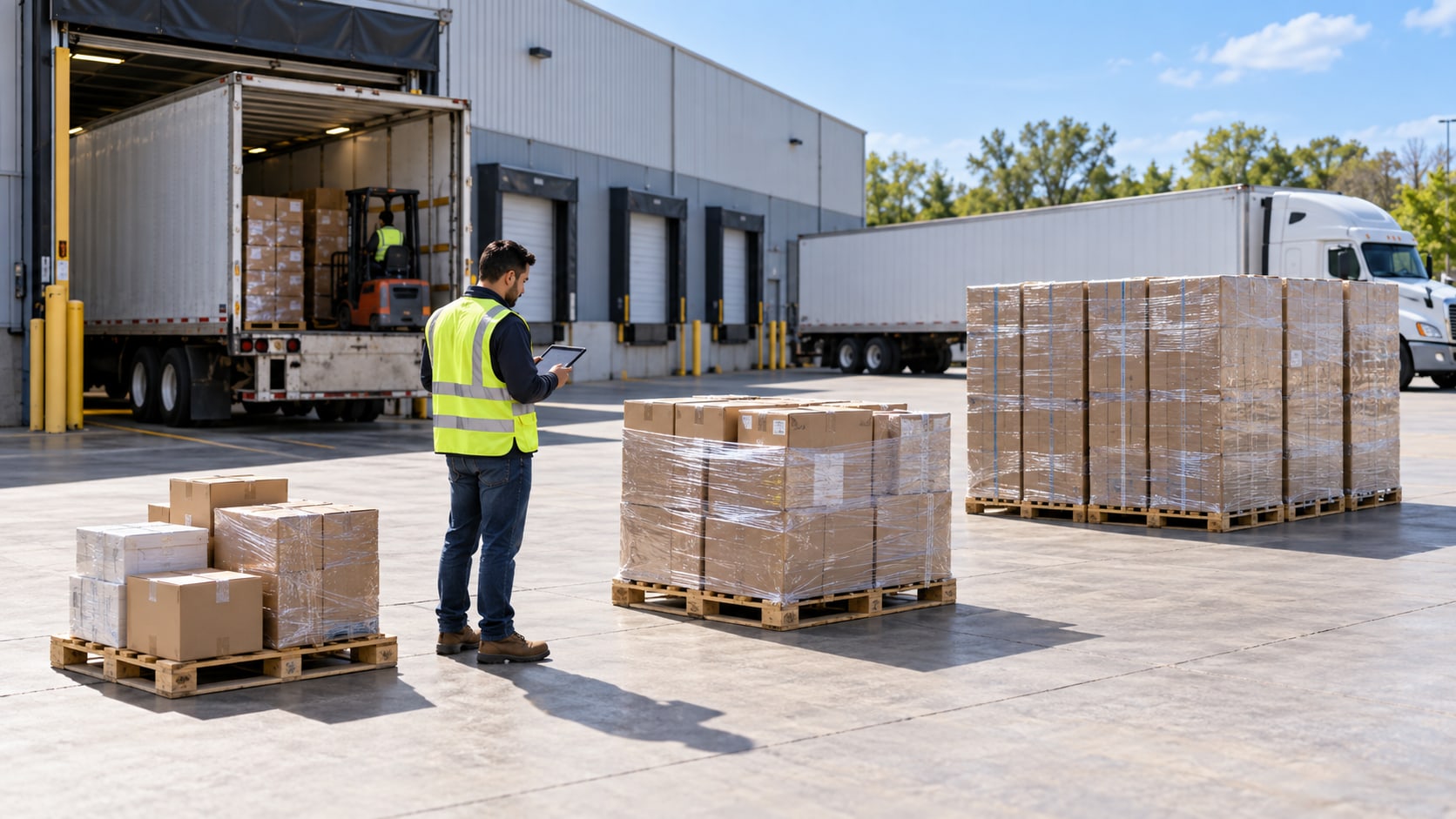
The service type decides how your freight is handled, how many times it is touched, how it is priced and how predictable the transit is. Getting it right matters more than most shippers expect, because the wrong service usually costs money in a way that does not show up until the invoice or the damage claim.
The short answer
Start here
- A few pallets, not urgent, can tolerate handling — LTL
- Too big for LTL, too small to fill a trailer, or fragile — partial truckload
- Fills a trailer, or you want it untouched and direct — full truckload
- The date is the whole point — expedited
- One truck, several pickups or deliveries — multi-stop
LTL vs partial vs full truckload: what is the difference?
LTL shares a trailer with other shippers' freight and moves through terminals, priced mainly on class, density and weight. Partial truckload takes part of one trailer and usually stays on it the whole way, priced on the space it uses. Full truckload gives you the whole trailer, loaded once and unloaded once, priced on the lane and the truck. The sections below show why handling, not just size, separates them; LTL vs FTL and partial truckload go deeper.
How they actually differ
The real difference is not size. It is how many times your freight gets handled and whether it shares the truck.
Every terminal an LTL shipment passes through is another chance for it to be moved, restacked, delayed or damaged. That is the tradeoff you are making when you choose LTL to save money, and it is a reasonable trade for durable, well-built freight. It is a bad trade for anything fragile, oddly shaped or time-sensitive.
What changes the price
| Service | Priced mainly on | Handling |
|---|---|---|
| LTL | Class and density, weight, lane | Terminal to terminal, several touches |
| Partial | Linear feet or space used, weight | Usually loaded once |
| Full truckload | The lane and the truck, not the pallet count | Loaded once, unloaded once |
| Expedited | Speed and equipment commitment | Direct, often team-driven |
| Multi-stop | Base lane plus each additional stop | One load, several handoffs |
What to send whichever service you need
The details that decide the service
- Pallet or piece count, and whether they stack
- Dimensions of each piece and the total weight
- Pickup and delivery ZIPs
- Dock, forklift or ground level at each end
- Dates, and whether they are firm
- Commodity and anything fragile or unusual
If you are not sure which service fits, send those and we will tell you. Choosing between LTL, partial and truckload for a given load is routine work, and it is faster for us to do it than for you to guess.
Not sure which service fits?
Send the pallet count, weights, ZIPs and dates. We will price the options that make sense and tell you which one we would use.
Request a Freight Quote