
Freight calculators & planning tools
Check space, equipment, routes and permit requirements.
Free to use. No signup required. The six calculators run right in your browser.
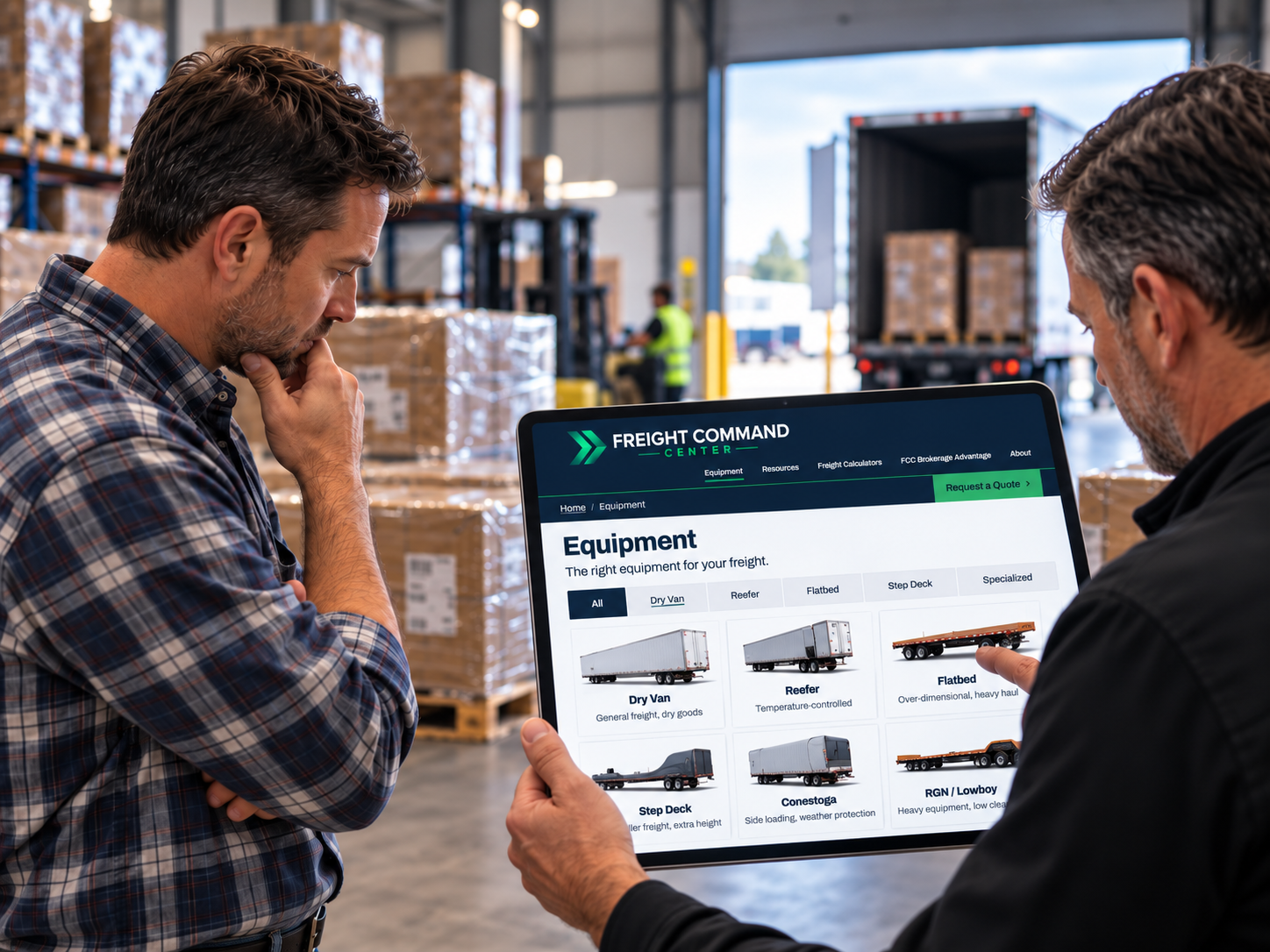
Freight calculators
-
Linear Feet Calculator
How much trailer floor will my freight use?
-
Trailer Capacity Calculator
How many pallets will fit?
-
Freight Density Calculator
What is my freight density?
-
Dimensional Weight Calculator
Could size matter more than actual weight?
-
Equipment Selector
What truck or trailer should I start with?
-
Reefer Temperature Converter
What is my reefer setpoint in °F or °C?
These tools provide planning estimates, not live carrier rates. Request a freight quote for your shipment.
Planning estimates need confirmation
Interior figures are nominal. Wheel wells, bulkheads, reefer equipment, load bars and individual trailer build all reduce usable space. Flatbed height is open, so height limits come from legal and permit rules rather than the trailer. Carrier rules, classification and usable capacity vary by carrier, equipment and commodity. Route estimates use general road routing, not truck routing.
What to send us
A result near a limit, or a load you have never shipped before, is worth a second look before it books. These details let us check it against the actual trailer and carrier:
- Piece count, plus the length, width, height and weight of each handling unit
- Whether the freight can stack, turn or ride on its side
- How it loads and unloads: dock, forklift, liftgate or crane
- Pickup and delivery access, appointments and hours
- The commodity, so equipment and class can be confirmed
Nothing is booked until you approve the rate.
Send us the shipment detailsCommon freight-calculator questions
How many pallets fit in a 53-foot trailer?
For standard 48 x 40 pallets on the floor of a 53-foot dry van, the usual figure is 26 loaded straight or 30 turned. Stacking can roughly double that; the individual trailer and the weight limit can lower it. Check your own pallets with the Trailer Capacity Calculator, or read how many pallets fit in a 53-foot trailer.
What does linear feet mean in freight?
It is how much of the trailer floor’s length your freight takes up, measured from the front toward the doors. It matters most for freight that cannot be stacked and for partial loads, and LTL carriers can apply their own linear foot rules. Estimate it with the Linear Feet Calculator.
How do I calculate freight density?
Multiply the greatest length, width and height of the handling unit in inches, multiply by the number of identical units and divide by 1,728 to get cubic feet. Then divide the total weight by the cubic feet, or let the Freight Density Calculator do it.
Does density always determine freight class?
No. The NMFC changes that took effect July 19, 2025 expanded the standard density scale from 11 to 13 subprovisions and moved more than 2,000 items toward density-based classification. The class still comes from the correct NMFC item, and items with handling, stowability or liability concerns may not follow density. Send us the commodity and we’ll confirm it.
Can pallets be turned sideways in a trailer?
Often, yes: in a 53-foot dry van, 26 standard 48 x 40 pallets loaded straight become 30 turned. Check that the pallets can be picked up from the turned side and the freight can travel that way. The truck and pallet loading guide covers the loading patterns.
What trailer do I need for my shipment?
Start with the Equipment Selector. It suggests a starting point among dry van, reefer, flatbed, box truck and cargo van from what you ship, its weight, temperature needs and loading access. The Equipment Guide covers 20 trailer and truck types. Still not sure? Send us the details.
Need help checking your shipment?
Send us the details so we can confirm equipment and pricing for the actual load.