
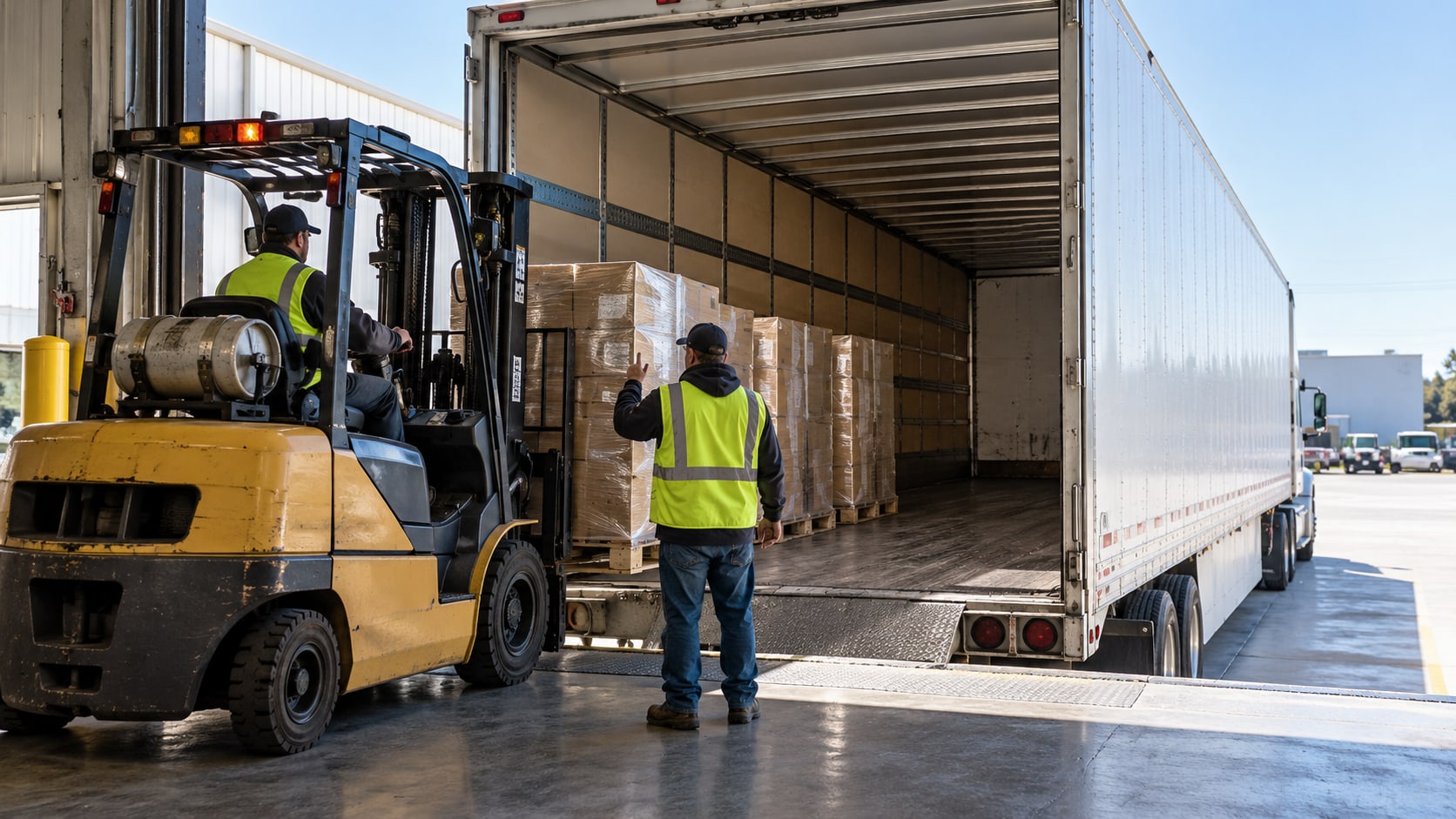
Partial truckload — sometimes called volume LTL — means your freight occupies part of a trailer alongside one or two other loads, rather than being broken into the LTL terminal network.
Why it exists
There is an awkward middle. Six to fifteen pallets is often too much for LTL to price well, and not enough to fill a fifty-three foot trailer. Sending it LTL means paying class-based rates on a lot of freight and accepting several rounds of handling. Sending it FTL means paying for trailer space you will not use.
Partial is the answer to that gap, and shippers routinely miss it because nobody told them it existed.
Why it often beats LTL on the same freight
Less handling. Partial freight is usually loaded once and unloaded once, the same as truckload. It does not go through terminals. For anything fragile, tall, or awkward to restack, that alone can be worth more than the price difference.
Priced on space, not class. Partial is generally rated on the floor length you occupy and the weight, rather than on freight class. If your freight is light and bulky — the kind that classes badly and gets expensive in LTL — partial can be substantially cheaper for exactly the same move.
Fewer opportunities to go wrong. Fewer touches means fewer chances for a pallet to be broken down, mislabelled or separated.
Why linear feet is the number that matters
LTL thinks in class and weight. Partial thinks in floor length. Your cost is driven by how much of the trailer's length you occupy, because that is what the carrier cannot sell to anyone else.
That has a practical consequence: whether your pallets can be turned, and whether they can be stacked, changes your price directly. Two pallets side by side use half the floor length of two pallets in a line.
Work out your figure with the linear feet calculator, and see what turning or stacking does to it.
Tell us if it can stack
Stackable freight can halve the floor length you pay for. If your pallets can take weight on top and nobody says so, you are quoted as if they cannot.
When partial fits
- Roughly six to eighteen pallets, though the range moves with the freight
- Freight that classes badly in LTL because it is light and bulky
- Fragile or awkward freight that should not be handled repeatedly
- Shipments where the date matters but not enough to pay for a dedicated truck
- Freight that cannot be stacked, so LTL charges for space above it regardless
When it does not
- Very small shipments, where LTL is genuinely cheaper
- Freight that fills a trailer anyway
- Firm, tight delivery dates, since partial can wait for a compatible load
- Anything needing exclusive use of the trailer, or specific temperature control alongside other freight
What to send
Details that price a partial
- Pallet or piece count
- Dimensions of each, and the total weight
- Whether they stack, and how high
- Whether they can be turned
- Pickup and delivery ZIPs
- Dock or forklift at each end
- Date range rather than a single day, if you have flexibility
That last one matters more on partial than on any other service. Partial moves get built around other freight, so a day of flexibility genuinely changes what we can find.
Stuck between LTL and a full truck?
Send the pallet count, dimensions and weights and we will price it as LTL, partial and truckload so you can see all three.
Request a Freight Quote