
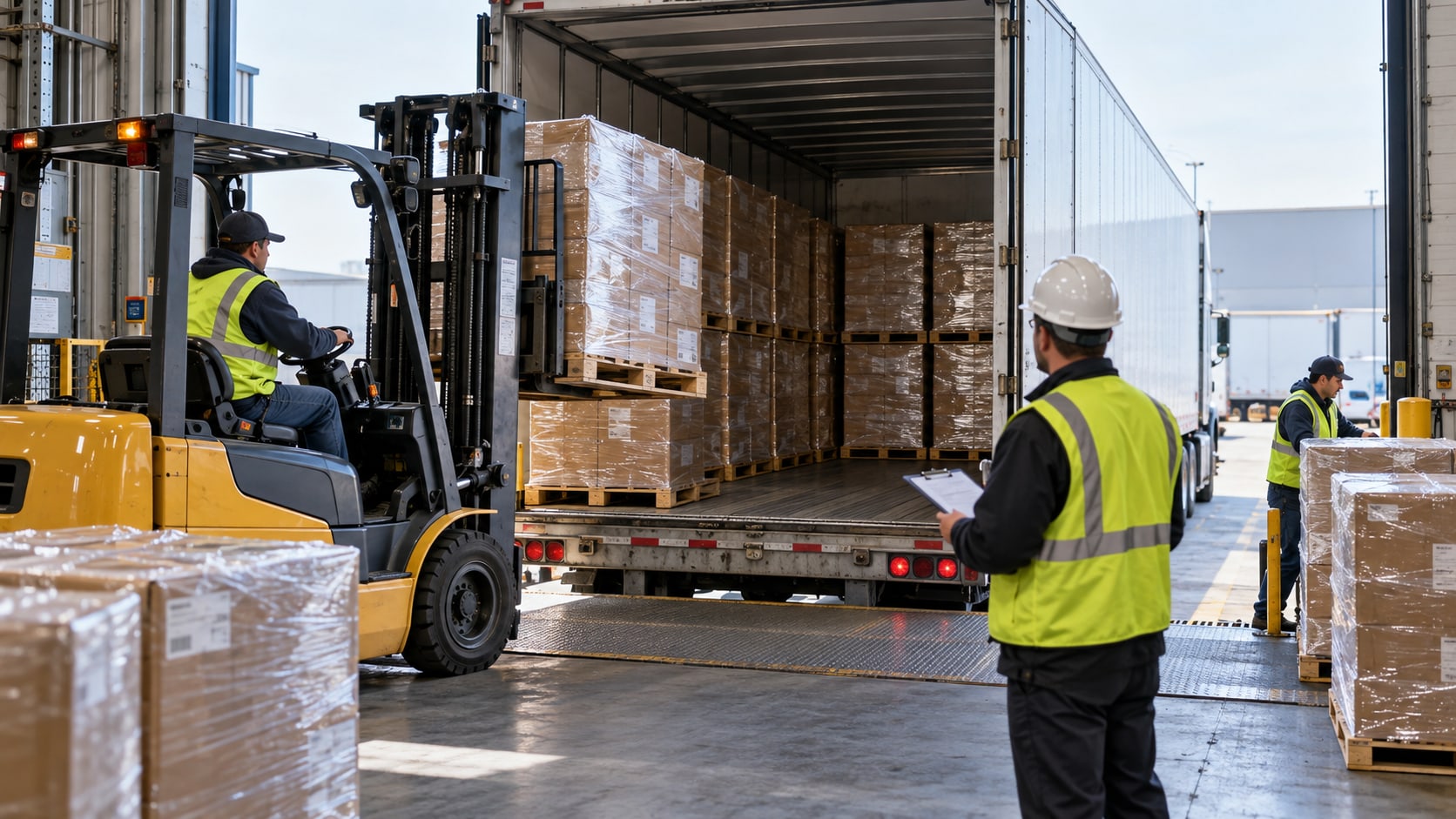
This is a quick reference for warehouse teams: the common pallet-loading patterns, what each one is good for, and the loading practices that decide whether a load arrives clean.
Before you load
Confirm the actual trailer dimensions, weight capacity, pallet dimensions, commodity requirements and securement requirements for the specific shipment. Usable space varies between individual trailers.
Common pallet loading patterns
Five patterns cover almost everything. The right one depends on your pallet dimensions, the trailer, and what the freight will tolerate.
Straight loading. Pallets in even rows, every pallet facing the same way.
Best for standard-size pallets, consistent freight, and loads where the pallet count is not extremely tight. Watch for unused space side to side, depending on how your pallet dimensions divide into the trailer width.
Turned loading. The same pallets rotated ninety degrees. Some warehouses call it sideways loading.
Best for pallet dimensions that divide into the trailer more efficiently when rotated. Watch for forklift access and pallet construction, since turning a pallet changes which way it is being carried.
Pinwheel loading. Orientation alternates along the trailer so the blocks interlock.
Best for mixed pallet orientations and loads where straight loading leaves gaps that cannot be used. Watch for the planning it takes. A pinwheel set out wrong is worse than a straight load done right.
Distributed loading. Pallets deliberately spaced through the trailer rather than packed into one area.
Best for heavy freight, partial truckloads, and any load where weight distribution matters more than the pallet count. Watch the gaps: space left on purpose still needs blocking, bracing or securement so freight cannot travel into it.
Block loading. Pallets grouped tightly together into a solid block.
Best for uniform palletized freight of similar height and weight on full truckloads. Watch for the assumption that tight means secure. A packed trailer is not automatically a secured trailer.
Weight distribution matters more than fit
The question that gets asked is whether it will fit. The question that matters is where the weight is going.
A trailer can have room for every pallet and still be loaded badly. Heavy pallets concentrated in one section create handling problems and can contribute to axle-weight problems. Know your pallet weights before choosing a pattern.
Axle weights are a legal limit
Federal, state and permit rules differ, and a load that is legal on total weight can still be over on an axle. If a load is heavy or unusual, tell us before it is loaded rather than after it is weighed.
Load heavy freight with a plan
Do not treat a 500 lb pallet and a 2,500 lb pallet as interchangeable just because the footprints match.
When pallet weights vary
- Identify the heaviest pallets before loading starts
- Avoid concentrating heavy freight in one small section
- Keep the trailer balanced side to side
- Think about the unloading sequence while you load
- Coordinate unusually heavy freight with the carrier first
Loading by trailer type
Pallet counts and usable dimensions differ by equipment and by individual trailer. The equipment guide carries the typical weight and pallet figures for each type. Use those for planning, then confirm the specific trailer before you commit.
Dry van. General palletized freight. Plan for pallet orientation, freight height, total weight, unloading sequence, securement and door clearance.
Refrigerated trailer. A reefer is not a dry van that happens to be cold. Air has to go somewhere. Cargo placement needs to preserve airflow for the equipment and the commodity: keep clear of the return air chute, do not load to the roof, and mind rear and side clearances. Pulp temperature at pickup and the operating mode on the rate confirmation matter as much as the count.
Flatbed. Fundamentally different, because the freight is not surrounded by walls. Weight distribution, load position, dunnage, tie-down points, overhang and product protection all become part of the loading decision.
Box truck. These reach capacity by weight or by space depending on the freight, and often by weight first. Check the capacity, the door opening, liftgate capacity if one is fitted, and the stop sequence.
Sprinter or cargo van. Good for small and urgent shipments, but space disappears fast. Check the door opening, wheel-well clearance, piece weight, and what loading equipment is available at both ends.
Load for the delivery, not just the pickup
For multi-stop freight the load order has to support the delivery sequence while still preserving weight distribution and securement. See loading a multi-stop trailer for the operational guide.
Identify the stop sequence before the forklift starts, not after.
Check the pallets before they go in
A good loading pattern cannot rescue a failed pallet. If it is not stable on the dock, it will not become more stable in a moving trailer.
Reject or rebuild before loading
- Broken deck boards or damaged runners
- Leaning product or crushed cartons
- Loose stretch wrap
- Product extending past the edge of the pallet
- Unstable or uneven stacking
- Wet or contaminated pallets
- Missing labels
Eliminate unnecessary movement
Open space is not automatically a problem. Uncontrolled movement is. Depending on the freight and the equipment, a load may need load bars, straps, blocking, bracing, dunnage or edge protection. The right method depends on the cargo, the trailer and the applicable requirements.
Before the forklift goes in
Before a lift truck enters the trailer, check that the trailer is secured against movement, the dock interface is ready and the floor is safe to enter. See dock safety around freight trucks for the sourced checklist.
Forklift loading check
- Trailer properly positioned and secured for loading
- Trailer condition and floor checked
- Pallet weights and dimensions known
- Loading pattern and sequence agreed
- Overhead and side clearance checked
- Enter straight and under control
- Avoid contact with walls and reefer equipment
- Final look at the load before the doors close
Common loading mistakes
What goes wrong most often
- Loading without knowing pallet weights
- Putting all the heavy pallets together
- Ignoring the unloading order
- Leaving gaps the freight can travel into
- Using damaged pallets
- Blocking reefer airflow
- Ignoring product stack limits
- Assuming every trailer is identical
- Not checking freight dimensions first
- Rushing the final inspection
The final sixty-second check
Before the doors close:
- Is the freight stable?
- Is the weight reasonably distributed, side to side and front to rear?
- Is anything damaged?
- Is the freight secured where it needs to be?
- Is the unloading sequence right for the stops?
- Does temperature-controlled freight have the airflow it needs?
- Are the doors and freight clear of obstructions?
- Does anything look wrong?
If the answer to the last one is yes, fix it before the truck leaves. Load it right before it rolls. It protects the product, the equipment, the driver and the delivery.
Not sure how yours should be loaded?
Send us the pallet count, the weights and the stops. We will tell you what the load plan should look like before anything moves.
Request a Freight Quote