
The short answer
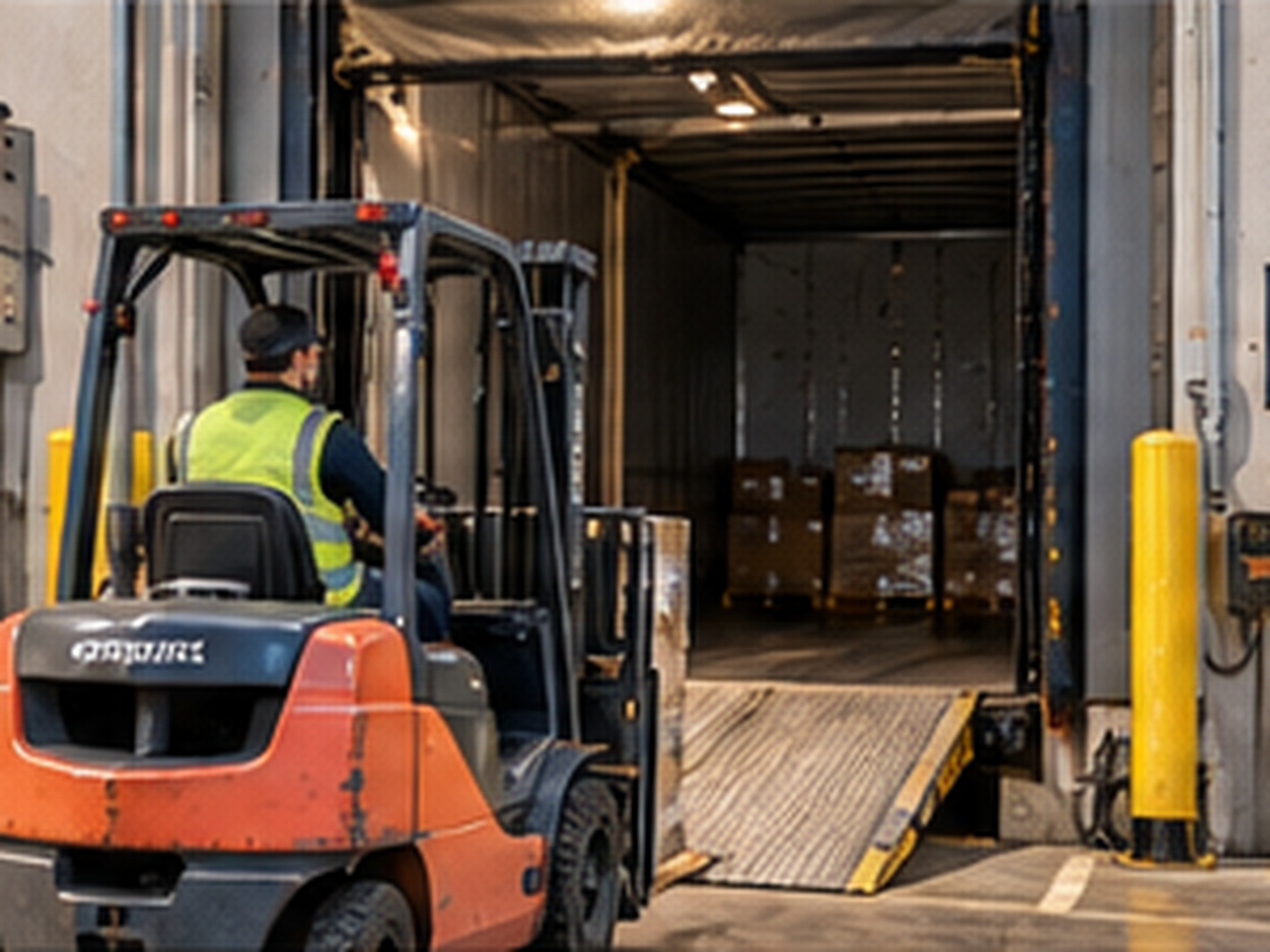
Do not let a forklift enter a trailer until the trailer, dock interface and powered-industrial-truck operation are safe for the task. OSHA specifically addresses trailer movement, dockboards and trailer-floor condition.
Do these first
These checks come before the forklift enters.
- Secure the trailer against unintended movement — use the method required for the operation and equipment.
- Check the dockboard or leveler — verify it is secured and adequate for the intended load.
- Check the trailer floor — OSHA requires checking for breaks and weakness before powered industrial trucks enter.
- Keep the dock edge controlled — powered industrial trucks must be kept a safe distance from dock edges.
Prevent unintended trailer movement
OSHA 1910.178 addresses preventing trucks and trailers from moving during loading and unloading.
OSHA also recognizes that mechanical trailer-restraint systems can provide equivalent protection to wheel chocks in applicable operations.
A 2005 OSHA interpretation further explains that FMCSA braking rules can preempt OSHA wheel-chock enforcement for some covered commercial motor vehicles.
The safe instruction is therefore:
Verify the trailer is secured against unintended movement using the method required for your operation and equipment before powered industrial trucks enter it.
Do not reduce that to one universal chock rule.
Check the dockboard
OSHA requires dockboards to be able to support the intended load.
Portable dockboards must be secured in position.
They also need protection against run-off.
The forklift, load and dockboard are one system. Do not treat the plate as an afterthought.
Check the trailer floor before entry
OSHA 1910.178 says flooring of trucks, trailers and railroad cars must be checked for breaks and weakness before powered industrial trucks are driven onto it.
Look for visible conditions that make entry unsafe.
This page does not attempt to create an engineering inspection standard.
Use inspect empty trailer before loading for the broader shipper-side condition check.
Forklift operation at the dock
OSHA requires powered industrial trucks to be operated by trained, authorized operators under the standard's training provisions.
OSHA also requires powered industrial trucks to keep a safe distance from the edge of ramps or platforms.
NIOSH separately emphasizes training and cautious operation around ramps and dock-related hazards.
Important to know
- Trailer movement control is part of the loading operation.
- Dockboard capacity and secure positioning matter before the forklift crosses it.
- Trailer flooring must be checked before forklift entry.
- Powered industrial truck operators must be trained as required by OSHA.
Do not assume
- OSHA requires the same wheel-chock method in every dock situation.
- A trailer that looks empty is automatically safe for forklift entry.
- A portable dockboard can be placed loose without securing it.
Sources
- OSHA 29 CFR 1910.178, Powered Industrial Trucks
- OSHA 29 CFR 1910.26, Dockboards
- OSHA Powered Industrial Trucks — Loading and Unloading
- OSHA Directive STD 01-11-007, Mechanical Means to Secure Trucks or Trailers to a Loading Dock
- OSHA interpretation, November 8, 2005
- NIOSH, Preventing Injuries and Deaths of Workers Who Operate or Work Near Forklifts
- NIOSH, Conducting a Daily Inspection of Powered Industrial Trucks
- NIOSH Forklift Toolbox Talk
Send the dock conditions before booking
Tell us whether the facility has a dock, restraint system, forklift access and any loading restrictions so the carrier arrives to a workable operation.
Request a Freight Quote