
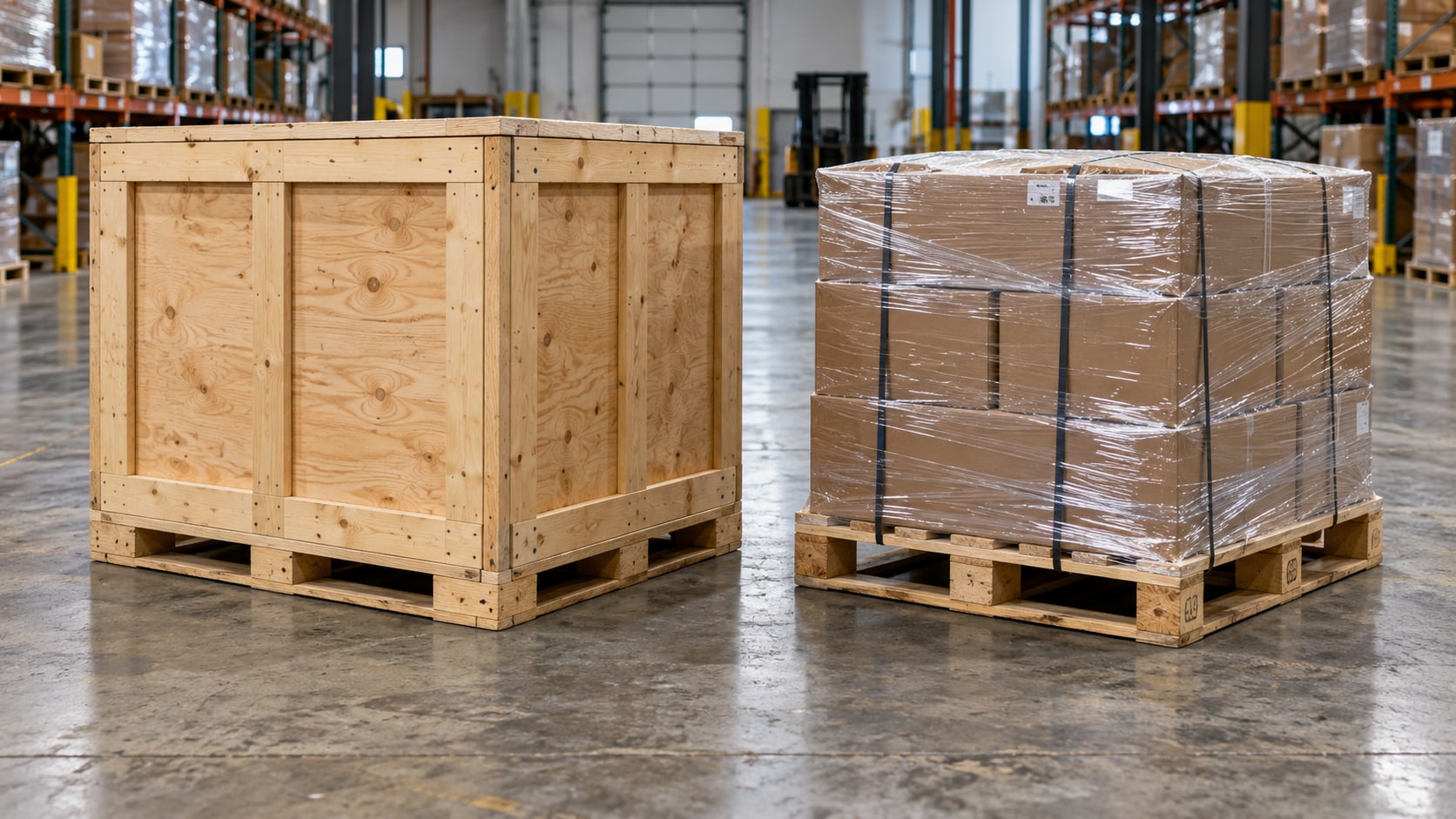
A pallet gives the forklift a base. A crate gives the freight a protective enclosure.
The right choice depends on what can realistically happen to the product during loading, transit, transfer and unloading.
When a pallet is usually enough
A pallet can work well when:
- Product is boxed or otherwise protected
- The load can be stacked into a stable footprint
- Stretch wrap or strapping can contain it
- Normal forklift handling will not expose fragile surfaces
- The freight can tolerate ordinary trailer vibration
- The load does not need a rigid enclosure
A well-built pallet is often lighter and uses less space than a crate.
See build a pallet that survives for pallet construction and containment.
When to consider a crate
A crate becomes more useful when freight is:
- Fragile
- High value
- Irregularly shaped
- Exposed machinery
- Sensitive to impact
- Unable to support stacking pressure
- Difficult to contain with ordinary wrap and straps
- Vulnerable to puncture or side contact
The crate creates structure around the freight instead of asking the product packaging to take every contact.
A crate adds weight
Wood, fasteners, internal supports and skids add tare weight.
That can affect:
- Total shipment weight
- Rating
- Trailer capacity
- Forklift requirements
- Handling
Weigh the finished crate or calculate a realistic final weight before quoting.
Do not quote from the bare product weight and add packaging later.
A crate also changes the dimensions
A crate increases the shipment footprint and height.
That can change:
- Pallet or floor positions
- Linear feet
- Equipment choice
- Door clearance
- Whether other freight can load beside it
Measure the finished outside dimensions.
Use the pallet capacity tool when floor space matters.
Crates need internal securement too
A strong outside box does not help if the product is loose inside it.
The product may still need:
- Blocking
- Bracing
- Bolting
- Padding
- Internal restraints
- Moisture protection
The goal is to keep the product from moving inside the crate.
Forklift access matters
A crate can be too heavy or too awkward for the handling equipment at pickup or delivery.
Confirm:
- Fork entry
- Center of gravity
- Finished weight
- Forklift capacity
- Dock or ground-level handling
- Rigging needs for unusually heavy freight
LTL handling may change the decision
Freight moving through an LTL network can experience additional handling.
A crate may make sense for freight that is too exposed for repeated handling, even when a direct truckload shipment could move safely on a pallet.
See LTL vs FTL.
Do not crate blindly
Crating everything can waste weight, space and money.
Ask what protection problem you are solving.
If the problem is only a loose stack of cartons, better palletizing may solve it.
If the product itself needs a rigid protective structure, a crate may be the better answer.
Crate-or-pallet checklist
Before choosing the package
- Can the product tolerate normal forklift and trailer handling?
- Is the product already protected by cartons or cases?
- Can the load be built into a stable pallet footprint?
- Are fragile surfaces exposed?
- Does the product need side or top protection?
- Will the finished package fit the planned equipment?
- Is the finished weight confirmed?
- Can pickup and delivery equipment handle it?
- Does the product need internal blocking or bracing?
Not sure whether the packaging changes the truck you need?
Send the finished dimensions, weight and handling requirements and we will help check the equipment and space before booking.
Request a Freight Quote