
Do these first
Before you file, protect your position and keep the claim moving.
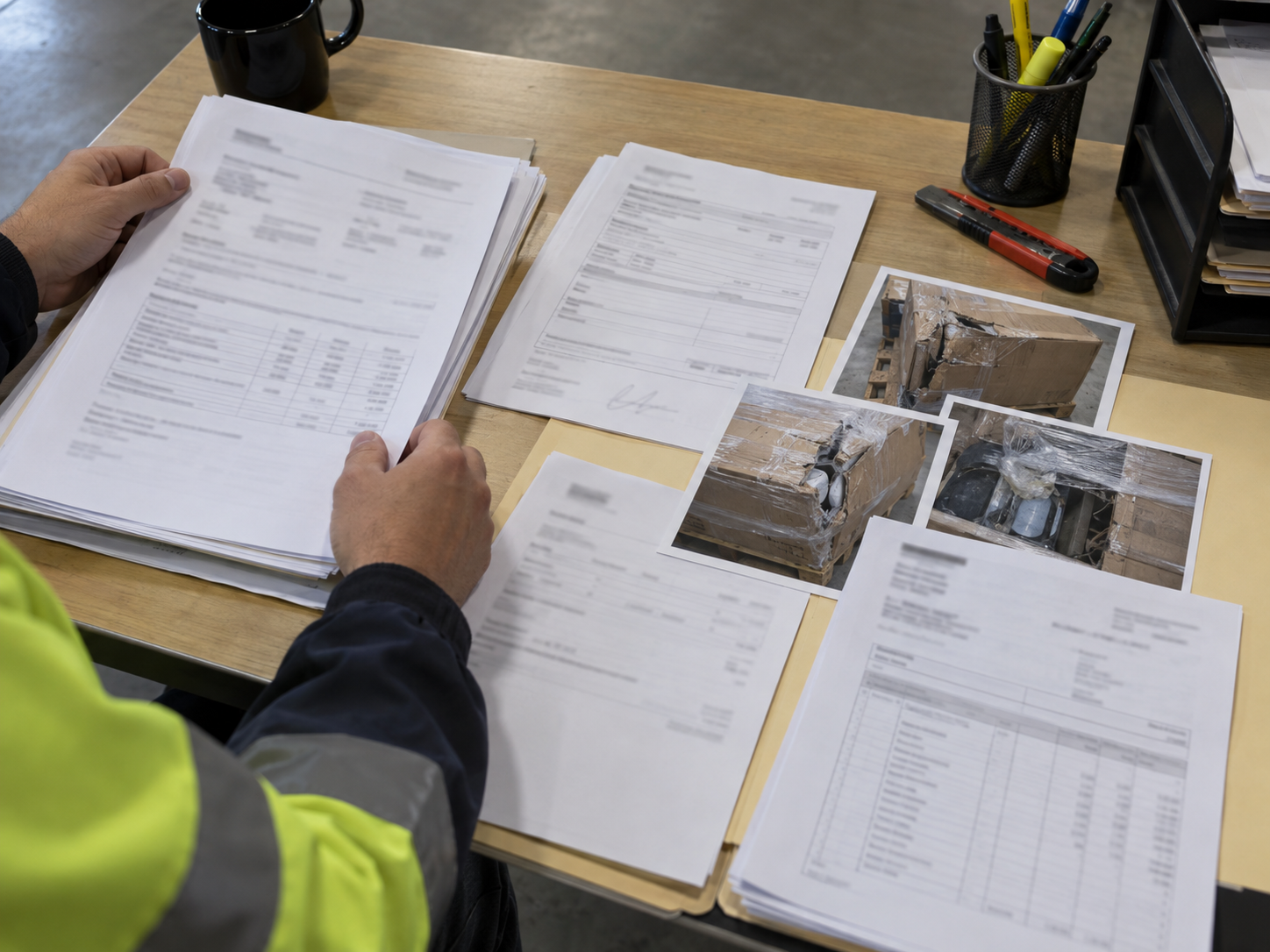
- Document the damage or loss — photograph it and write notes while the freight is still available to inspect.
- Save all the paperwork — bill of lading, delivery receipt, packing list and any inspection report.
- Do not move or alter the freight — keep it as it is in case the carrier asks to inspect it.
- Tell us what happened — the sooner it is filed and chased, the better it moves.
What a freight claim is
For interstate motor-carrier freight, the Carmack Amendment establishes carrier liability for actual loss or injury to property within its scope.
The claim is made against the motor carrier, not the broker. A broker can still organize documentation, submit the claim when authorized, follow up with the carrier and keep you informed.
The claim process, step by step
- Tell us what happenedAs soon as you find the problem. The earlier this starts, the more of it can still be documented.
- Gather the documentationThe bill of lading, the delivery receipt, the value support and the photographs.
- File the claim with the carrierA written claim that identifies the shipment, asserts the carrier is liable and states a specified or determinable amount.
- The carrier acknowledgesGenerally within 30 days of receiving the claim, unless it has already been paid or disallowed. (49 CFR 370.5)
- The carrier pays, declines or offersWithin 120 days it must pay, decline, or make a firm written compromise offer. If it is still open, it must say so in writing and why, then update every 60 days. (49 CFR 370.9)
- Follow up until it closesWe keep it moving, supply what the carrier asks for and tell you where it stands.
What makes a filing a claim
49 CFR 370.3 says a sufficient written claim must identify the shipment, assert carrier liability for the alleged loss or damage, and claim a specified or determinable amount.
A delivery-receipt notation or inspection report by itself is not the same thing as filing the formal claim.
What normally supports the claim
49 CFR 370.7 allows the carrier to require supporting documents needed for investigation. Common support includes the BOL, delivery receipt, value documentation, packing list where useful, photos and repair or loss support when applicable.
What happens after filing
49 CFR 370.5 generally requires acknowledgment within 30 days unless the carrier has already paid or disallowed the claim.
49 CFR 370.9 requires the carrier to pay, decline or make a firm written compromise offer within 120 days. If still pending, the carrier must provide a written status and reason for delay, then continue status updates at succeeding 60-day periods.
A 120-day rule is not a promise of payment
It governs claim disposition or status handling, not the amount or outcome.
How long do you have to file?
Do not treat nine months as a universal deadline.
49 U.S.C. 14706(e) says a carrier may not establish a Carmack claim-filing period shorter than nine months. The actual period comes from the bill of lading, contract or applicable transportation terms and can be longer.
Check the governing shipment terms.
Sources
- 49 U.S. Code § 14706 (Cornell LII)
- 49 CFR 370.3 (Cornell LII)
- 49 CFR 370.5 (Cornell LII)
- 49 CFR 370.7 (Cornell LII)
- 49 CFR 370.9 (Cornell LII)
Required documents
A complete filing usually includes:
- Bill of lading
- Delivery receipt or proof of delivery
- A description of the loss or damage
- Photographs of freight, packaging and labels
- Packing list or invoice showing value
- Inspection report, if one was made
- Salvage details, if any apply
Important to know
- The claim is against the motor carrier, not the broker.
- We assemble it, file it and chase it with the carrier.
- The filing period comes from the bill of lading. Federal law sets a floor a carrier cannot go below, not a single deadline.
- The carrier must acknowledge within 30 days and reach a disposition within 120. (49 CFR 370)
Do not assume
- That a clean delivery receipt ends the matter.
- That you have the same amount of time on every shipment. Check the bill of lading.
- That the broker pays the claim. It is with the carrier.
- That a filed claim will be paid in full. The carrier evaluates each one.
Need help getting a claim organized?
Send the load number, carrier, BOL, delivery receipt, value support and the damage or shortage documentation you already have.
Request a Freight Quote