
The short answer
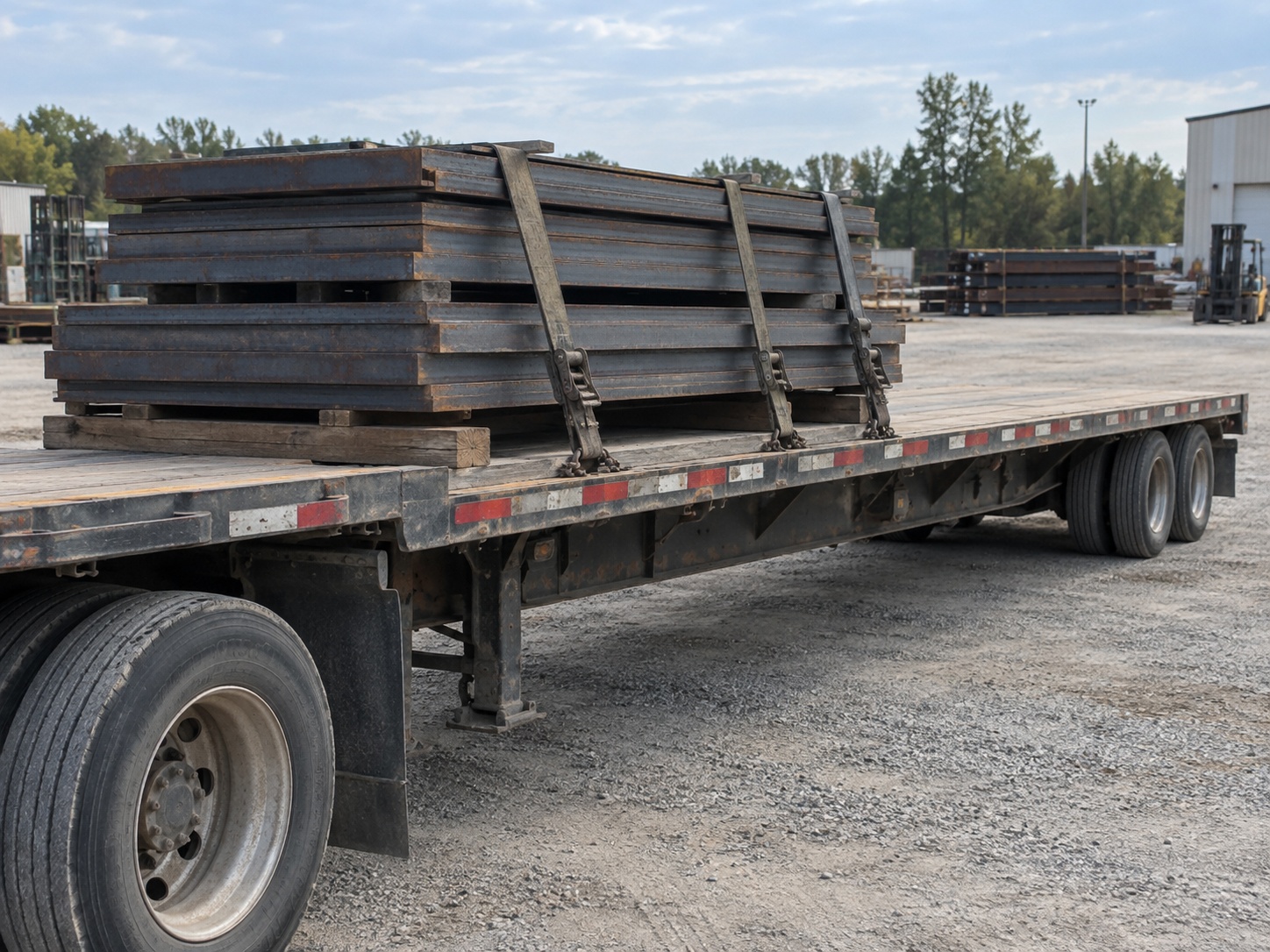
Steel can leave a trailer looking visually empty while the truck is already at its legal operating weight because the product is extremely dense.
Do these first
Start with weight by piece and the physical form of the steel.
- Identify the form — coil, plate, beam, bundle or pipe.
- Give piece and bundle weights — not just total weight.
- Give the loading method — crane, overhead crane or forklift.
- Describe unload capability — the destination has to handle the same product.
Different steel forms create different problems
Coils can roll and have commodity-specific securement rules.
Plate concentrates substantial weight into a relatively small deck area.
Beams create length and support-point problems.
Bundled steel depends on bundle integrity and banding.
Pipe has rolling potential and needs suitable support.
Weight distribution matters more than visual fullness
The truck must stay within legal gross and axle limits. A carrier may intentionally leave open deck space because adding more steel would create a weight or axle problem.
Important to know
- Open deck space does not mean unused legal payload.
- Piece position can matter as much as total weight.
- Steel edges can damage synthetic webbing and require appropriate protection or another securement method.
What to tell us
- Product form
- Number of pieces or bundles
- Weight of each piece or bundle
- Longest dimensions
- Loading method
- Unloading method
- Weather-protection requirement
- Any manufacturer handling instructions
Securement rules are commodity-specific
FMCSA has specific securement rules for several steel-related forms, including metal coils.
Source: https://www.fmcsa.dot.gov/regulations/cargo-securement/cargo-securement-rules
Do not assume
- A visually half-empty flatbed can legally take more steel.
- All steel is secured the same way.
- Synthetic straps are appropriate for every edge and product form.
Send the steel by form, not just by total weight
Give us the piece weights, dimensions, product form and loading method so the truck can be planned correctly.
Request a Freight Quote