
The short answer
A job site lacks many things a warehouse provides automatically. Access, stable ground, unloading equipment, site contact and receiving timing all have to be planned.
What to confirm, in order
- Site accessCan the planned truck legally and physically reach the unloading point?
- Ground conditionIs the surface paved, gravel, dirt, mud or sloped?
- Overhead clearanceAre there wires, branches or structures?
- Truck positionIs there enough room to enter, turn, stand and exit?
- Unloading equipmentForklift, telehandler, crane or other equipment must be confirmed.
- OperatorThe equipment needs a qualified operator in the delivery window.
- Freight handlingIdentify lifting points, size and special placement.
- Site contactA named person must be reachable.
- Delivery windowMatch truck ETA with actual site hours.
Access comes first
A valid street address does not prove a tractor-trailer can reach the unloading point. Check road width, turning room, gates, temporary fencing, low wires and construction traffic.
Exact delivery point
A job-site address is often a mailing address, not the place the truck unloads. Give the gate or entrance name, the staging or laydown area, a site contact with a mobile number, the hours trucks may enter and any driver check-in, orientation or PPE rules. A contact who moves around the site still needs to answer when the driver calls.
Ground conditions matter
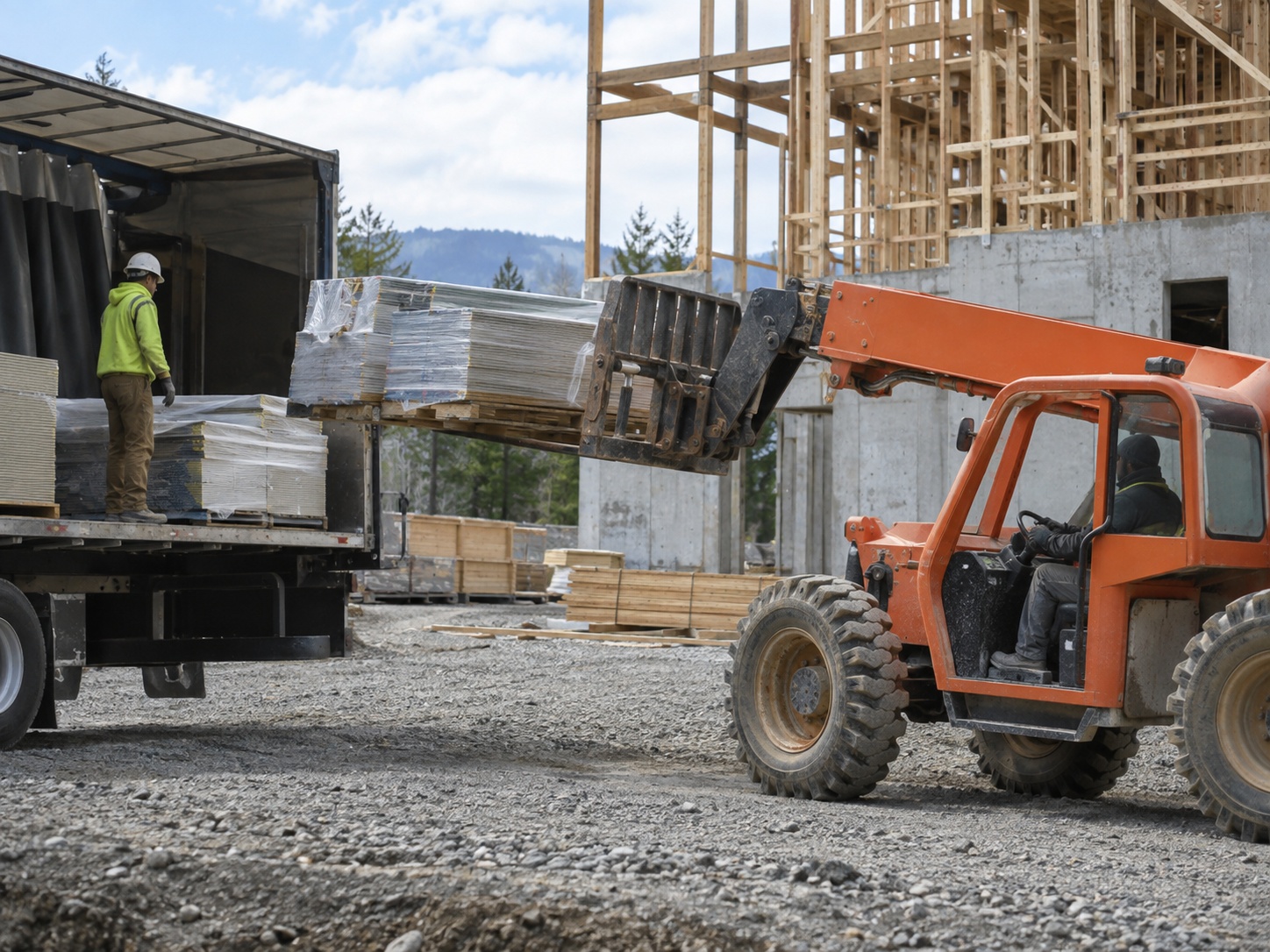
Mud, gravel, soft ground and slopes can make normal pallet handling impossible. If freight will move by telehandler or rough-terrain forklift, disclose that plan.
Who unloads?
Do not assume the driver brings lifting equipment. Confirm equipment, capacity, reach, operator and timing.
Does the truck need a liftgate?
Maybe. A liftgate helps when palletized freight has to come down from trailer height and there is no dock or suitable forklift. It does not solve every site problem: long, oversize or very heavy freight usually needs a forklift, telehandler or crane instead, and liftgate platforms have size and weight limits. See liftgate service.
If the customer or site is supplying the forklift or crane, the requirement has not gone away: it still has to be confirmed, sized for the load, operated and there when the truck arrives.
Does a construction site need an appointment?
Usually some form of coordination, but the rule depends on the site and the carrier. Confirm whether a set appointment, a call before arrival or a delivery window applies, whether trucks are taken first come, first served, and whether someone must meet the driver at the gate. Site working hours are not the same as guaranteed unloading. See appointment terminology and notify vs appointment.
Can a job site create extra charges?
Yes, depending on the carrier and service. Many LTL carriers treat construction sites as limited-access locations, which can carry its own charge: see limited-access delivery. Liftgate, inside delivery, notification or appointment, detention, redelivery, reconsignment and specialised equipment can also apply. The time to name them is at quote, not when the truck is at the gate. See accessorial charges.
What to tell us
- Exact site address and entrance
- Truck-size restrictions
- Road and ground condition
- Overhead restrictions
- Unloading equipment
- Operator availability
- Freight dimensions and weight
- Delivery window
- On-site contact and phone
Do not assume
- A map pin proves the truck can enter.
- Any forklift has enough capacity or reach.
- The driver can wait indefinitely for people or equipment.
Before a job-site delivery is dispatched
- Exact address and correct entrance or gate confirmed
- Site contact and mobile number confirmed
- Receiving hours and entry rules confirmed
- Appointment or call-ahead requirement confirmed
- Truck size and access confirmed
- Ground and surface conditions confirmed
- Unloading method and equipment confirmed
- Forklift, crane or liftgate responsibility confirmed
- Site PPE or orientation rules confirmed where they apply
- Freight dimensions and weight confirmed
- Permits and route confirmed if the load is oversize
Oversize equipment going to a job site
Treat it as two problems that must both be solved: can the load legally travel the route, and can the site physically receive and unload it? A permit does not prove the machine can get through the site gate, and a site that can unload it does not make the highway move legal. Plan the route and permits with the State Permit Guide, keep the site-receiving plan beside it, and check the load against equipment in the Freight Load Planner.
Sources
Tell us what the job site actually looks like
Send access, ground, unloading equipment, site contact and delivery-window details before booking.
Request a Freight Quote